

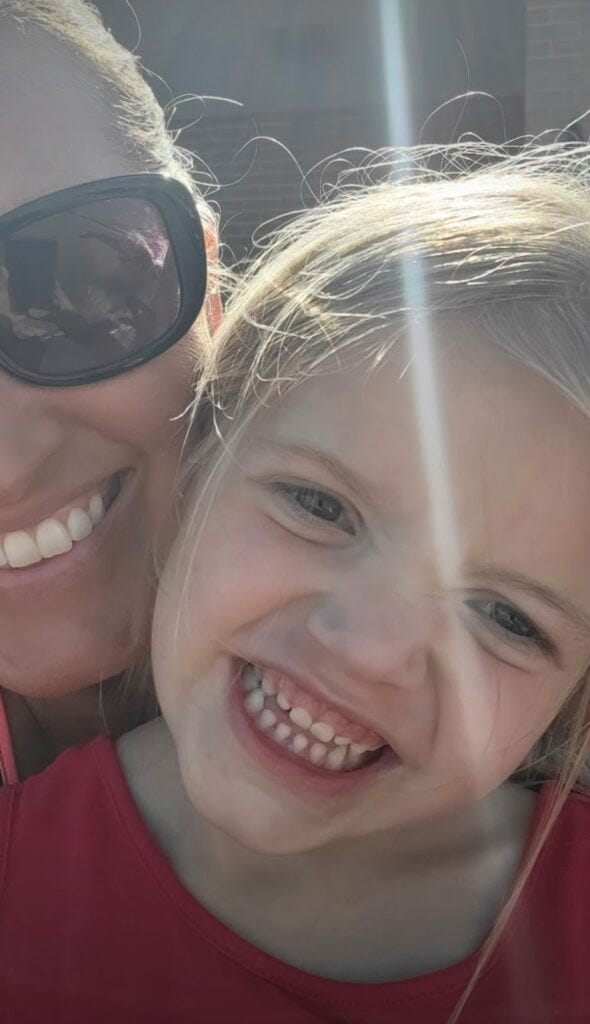
Kenlee is Free
After 827 days, a Navarre mother has her daughter back — and Florida’s child-welfare system is finally being forced to answer for how this happened.
On June 10, 2026, Kenlee Zuraff walked back through the door of her family’s home in Navarre.
For two years, three months, and four days, that sentence was the prayer of a single mother, a sister, a community, and thousands of people across the country who watched a five-year-old girl with cystic fibrosis taken from her driveway and sent six hours away.
She is eight now. She is home.
That is the headline. Everything else is the story of how a family had to fight the State of Florida to make it true — and why that fight is not finished.
The afternoon that was supposed to close a case
March 6, 2024, started as an ordinary Navarre afternoon. Joy Zuraff had taken her then-five-year-old daughter, Kenlee, to the park. Swings. Sunshine. A short break from the daily work of raising a child with cystic fibrosis — the vests, the nebulizers, the medications, the second opinions.
A friend called. The Department of Children and Families was coming by, the friend said. Just a look. They were going to close the case.
Instead, DCF workers arrived with armed Santa Rosa County deputies. Body-camera footage later showed the scene that shocked the country: a mother on her own driveway, asking why her little girl was being taken “because of one medication,” while state workers accused her of refusing treatment and predicted a lung transplant if she did not comply.
Joy has always said she was not denying care. She was seeking a second opinion. She was asking hard questions about a CFTR modulator that carries an FDA black-box warning, including risks to the liver. She was a mother doing what mothers are supposed to do when the stakes are a child’s lungs.
The state called it medical neglect. Within minutes, Kenlee was gone.
She was moved through hospitals and then into a medical foster placement in the Jacksonville area — roughly six hours from home. For nearly two years, Joy and Kenlee’s sister made the weekly drive: twelve hours on the road for a visit with a child who belonged in her own bed.
Joy was placed under a gag order by Circuit Judge J. Scott Duncan. The mother who most needed to tell this story was forbidden from telling it. That is why using our non-profit Magic Feathers, we created FreeKenlee.com. We speak for a mother who can’t.
What the video showed — and what the system tried to hide
The bodycam did not show a child in present danger. It showed a home with CF treatment equipment in the common area. It showed a mother who knew her daughter’s medications well enough that the workers themselves asked her how to administer them. It showed no emergency, no chaos, no imminent harm.
DCF later said a short clip “does not capture the full scope or context.” The Governor’s communications office said the facts did not support the accusations being made in public. The department declared the child “safe and no longer in imminent danger.”
What the public saw was a mother losing her daughter over a treatment disagreement — and a bureaucracy that would rather take a child than tolerate a parent who asked questions.
Doctors’ statements were used against her. Social workers’ characterizations hardened into court filings. The agency moved toward termination of parental rights. Two years in the life of a child with cystic fibrosis is not an administrative delay. It is a childhood.
Then the political powerhouses walked in
The case did not move because the system suddenly remembered its own statute — the one that says family ties should be preserved whenever possible. It moved when people with names the agency could not ignore walked into the room.
Retired local nurses Sherry Chapman and Cindy Smith refused to let the file die in a drawer. They carried it to Tallahassee.
“We the Patriots” first elevated this case to national attention and raised $23,000 for legal costs.
Stephanie Hansen and Dale Richardson promoted Joy’s case, sharing the bodycam footage and an interview with Joy prior to her gag order.
Sen. Don Gaetz, Joy’s own Northwest Florida senator, made the case his business. He said aloud what families in this circuit have said for years: very little had been done for two years, and a lot needed to be done soon. He said the department’s sudden interest in reunification appeared to exist because four senators were watching.
Keri Pitzer is a member of Sen. Don Gaetz staff and was instrumental in getting this case attention.
Sen. Jason Pizzo, a Miami attorney and former prosecutor, took Joy’s case pro bono. He drove the length of the state to stand next to a Navarre mother the system had tried to silence. He called what he found “a system set up to fail, forcing a mother to drive six hours each way just to visit her child.” Then he said the sentence the Legislature needed to hear: Shame on all of us.
Sen. Jennifer Bradley and Sen. Erin Grall joined them. In the House, Rep. Nathan Boyles pledged support. The four senators pressed DCF while the agency’s own secretary was seeking confirmation. Reunification stopped being a slogan and became a plan.
In April 2026, Kenlee was finally moved out of Jacksonville and placed with a foster caregiver in Santa Rosa County — back in her own judicial circuit, close enough for a mother to be a mother again. Pizzo walked out of court and said the process was going well.
On June 10, 2026, the process produced the only result that ever mattered.
Kenlee came home.
What homecoming does — and does not — settle
The law still requires a period of supervision. As of the September 4 hearing at the Santa Rosa County Courthouse, the case is expected to close in December, after the statutory six months. Pizzo has already said that requirement should be revisited — three months, not six, when a child has already lost two years.
Joy remains under Judge Duncan’s gag order. Leaving court on September 4, she could not tell the cameras what those 827 days felt like. She could say one thing. The crowd heard it.
“Pizzo for President.”
The room answered her.
Homecoming is not the same as justice. A child was taken across the state over a medical disagreement, kept away from her mother and sister, and returned only after senators, nurses, neighbors, a mural on Pensacola’s Graffiti Bridge, prayer vigils at the courthouse, national coverage, and two years of public pressure made inaction more expensive than doing the right thing.
That is not how a child-protection system is supposed to work.
The grand jury said the quiet part
Days before that September courthouse press conference, a Fifth Judicial Circuit grand jury described DCF in language the agency cannot spin:
“Heartbreaking, systemic patterns of neglect and abuse.”
“Operational failures.”
“Failing catastrophically.”
Senators Gaetz, Pizzo, Bradley, and Grall answered with a joint statement that should be carved into the wall at DCF headquarters:
“The Grand Jury’s report confirms many of the serious concerns we encountered about practices of the Department and its contractors in the wrongful termination of parents’ rights, including grossly incompetent casework, cruel treatment of children, unqualified clinical personnel, wasteful and improper use of funds, and numbingly bureaucratic obstacles. This report makes clear that these are not isolated problems but systemic failures.”
Gaetz stood on the courthouse steps and said it a second time: We have a systemic failure of the governmental agency that is supposed to protect and support Florida’s children and Florida’s families.
Dozens of other families showed up that morning with their own files. They described collusion, fraudulent assertions used to take and keep children, grandparents frozen out, and a State Attorney’s office that would not take the evidence. They are not footnotes to Kenlee’s story. They are the reason her story had to become a movement.
Effective October 1, FamiliesFirst Network will no longer run child-welfare case management in the First Judicial Circuit. New contractors are coming in. Changing the logo on the badge is not reform. Changing the law is.'
What reform now looks like in Tallahassee
Senator Gaetz is drafting legislation with Pizzo, Bradley, and Grall. The bill is still being written. The principles are not.
Among the provisions he put on the record September 4:
Limit DCF’s power to seek termination of parental rights, and require the secretary of DCF — not a low-level bureaucrat — to review and approve every TPR request.
Give parents real due process: the right to present evidence, dispute false information, and challenge the agency without fear of reprisal.
Put legal consequences on falsified documents and false statements made to courts.
End the practice of shipping children hundreds of miles from home, which Gaetz called a “huge barrier to unification.”
Require credentialed clinicians. Fine and cancel contractors who let unqualified people treat children.
Carry forward the medical second-opinion protections in Patterson’s Law — and go further.
Strip the shield of sovereign immunity where contractors harm children and families through misconduct, negligence, or lies.
Make contracts performance-based, with the Legislature actually overseeing DCF instead of trusting DCF to oversee itself.
Spend child-welfare money on child welfare — not executive compensation and sloppy procurement.
Gaetz warned the room what taking on this agency feels like. A colleague once compared it to walking into the Okefenokee Swamp. Many enter. Many are lost. There are few happy endings.
June 10 was one of them. It should not have required a swamp.
To the people who carried this family
To Sherry Chapman and Cindy Smith, who treated a neighbor’s child like their own case file.
To Sen. Jason Pizzo, who billed nothing and showed up for everything.
To Sen. Don Gaetz, who used the power of a district to defend a constituent the system had decided to erase.
To Sens. Bradley and Grall, Reps. Boyles and Salzman, and every legislator who decided this file was not “just another dependency.”
To the families who stood in that courthouse parking lot and said me too.
To everyone who shared the bodycam, painted the Graffiti Bridge mural of a mother holding her daughter, stood vigil in Milton, donated, prayed, called, wrote, and refused to look away.
To Kenlee’s sister, who rode those twelve-hour weeks.
To Joy — gagged, exhausted, still standing.
You brought a little girl home.
The work left
Kenlee is home. The supervision clock is still running. The gag order is still in place. The legislation is still a draft. The grand jury’s 34 recommendations are still paper until they are statute.
Other children in this state are still six hours from their mothers over a disagreement a second doctor should have been allowed to settle.
So celebrate. Then stay in the fight.
If you have evidence that fraud was used against your family in a DCF case, the senators at that courthouse told you to take it to law enforcement. If your senator has not called DCF about a child who should be home, make them. If Tallahassee wants a name for the bill, they already have one.
Kenlee is home.
Make sure the next child never has to leave.
Joy Zuraff remains under a court gag order and cannot speak freely about pending matters. This account is drawn from public reporting, on-the-record statements by her counsel and state legislators, court-adjacent press conferences, and the public record of the Fifth Circuit grand jury’s findings. The case is expected to close in December 2026 following a required supervision period.
Support the family and the work that remains: Donate at FreeKenlee.com · Support@FreeKenlee.com
John Davidson
MagicFeathers.org
Thank you. Well said.
Glad this was handled the way it was. I know if it was my child, those agents would be changed people and I'd be in jail for decades or longer.